
How to Score a Cribbage Hand
 Written by Nobs editorial team
A cribbage hand is scored as five cards: the four you kept plus the starter. Add up every distinct combination in five categories: fifteens (2 points each), pairs (2, 6, or 12), runs (1 point per card), the flush (4 or 5), and nobs (1). The same card can sit in several combinations at once.
What scores points in a cribbage hand?
For counting purposes an ace is worth 1, pip cards are worth their face value, and jacks, queens, and kings are worth 10 each. Every combination in the table below scores separately, and a single card may belong to several combinations at the same time.
| Combination | Points | Watch for |
|---|---|---|
| Fifteen: any set of cards totaling exactly 15 | 2 each | Every distinct set counts; sets differing by one card are separate |
| Pair: two cards of one rank | 2 | Rank only; suits are irrelevant |
| Pair royal: three of a kind | 6 | Three of a kind is three pairs, never 2 + 6 |
| Double pair royal: four of a kind | 12 | Four of a kind is six pairs |
| Run: three or more consecutive ranks | 1 per card | Shorter runs inside a longer run never score separately |
| Flush: all four hand cards in one suit | 4 | A matching starter makes it 5; three cards plus the starter score nothing |
| Crib flush: all four crib cards plus the starter | 5 | The four-card version never counts in the crib |
| Nobs: a jack matching the starter's suit | 1 | Suits matter only for the flush and nobs |
How do you count a hand?
No rule authority requires you to count in any particular order. The sequence below is the practical convention almost every table uses, because it makes missed points easy to spot, and it is worth learning as a habit.
- Lay the hand out with the starter as a fifth card. The starter belongs to every hand and the crib at the show.
- Count the fifteens first, announcing a running total: "fifteen 2, fifteen 4", and so on. Every distinct set of cards adding to exactly 15 scores 2, and there is a whole craft to counting fifteens in depth when ranks repeat.
- Count the pairs. Two of a kind is 2, three of a kind 6, four of a kind 12.
- Count the runs at their longest. A run scores 1 per card, and a paired rank inside a run means the run counts once per copy of that rank.
- Check for a flush. Four hand cards in one suit score 4, or 5 when the starter matches too.
- Check for nobs. A jack in the hand matching the starter's suit adds 1.
A worked example
Take the hand 6♥ 7♦ 7♠ 8♣ with a 9♦ starter. Working through the five categories in order:
| Combination | Cards | Points | Running total |
|---|---|---|---|
| Fifteen | 7♦ + 8♣ | 2 | 2 |
| Fifteen | 7♠ + 8♣ | 2 | 4 |
| Fifteen | 6♥ + 9♦ | 2 | 6 |
| Pair | 7♦ + 7♠ | 2 | 8 |
| Run of four | 6♥ 7♦ 8♣ 9♦ | 4 | 12 |
| Run of four | 6♥ 7♠ 8♣ 9♦ | 4 | 16 |
The suits are mixed, so there is no flush, and with no jack there is no nobs. Spoken aloud at the table, the count runs "fifteen 2, fifteen 4, fifteen 6, a pair is 8, and a double run of four makes 16."
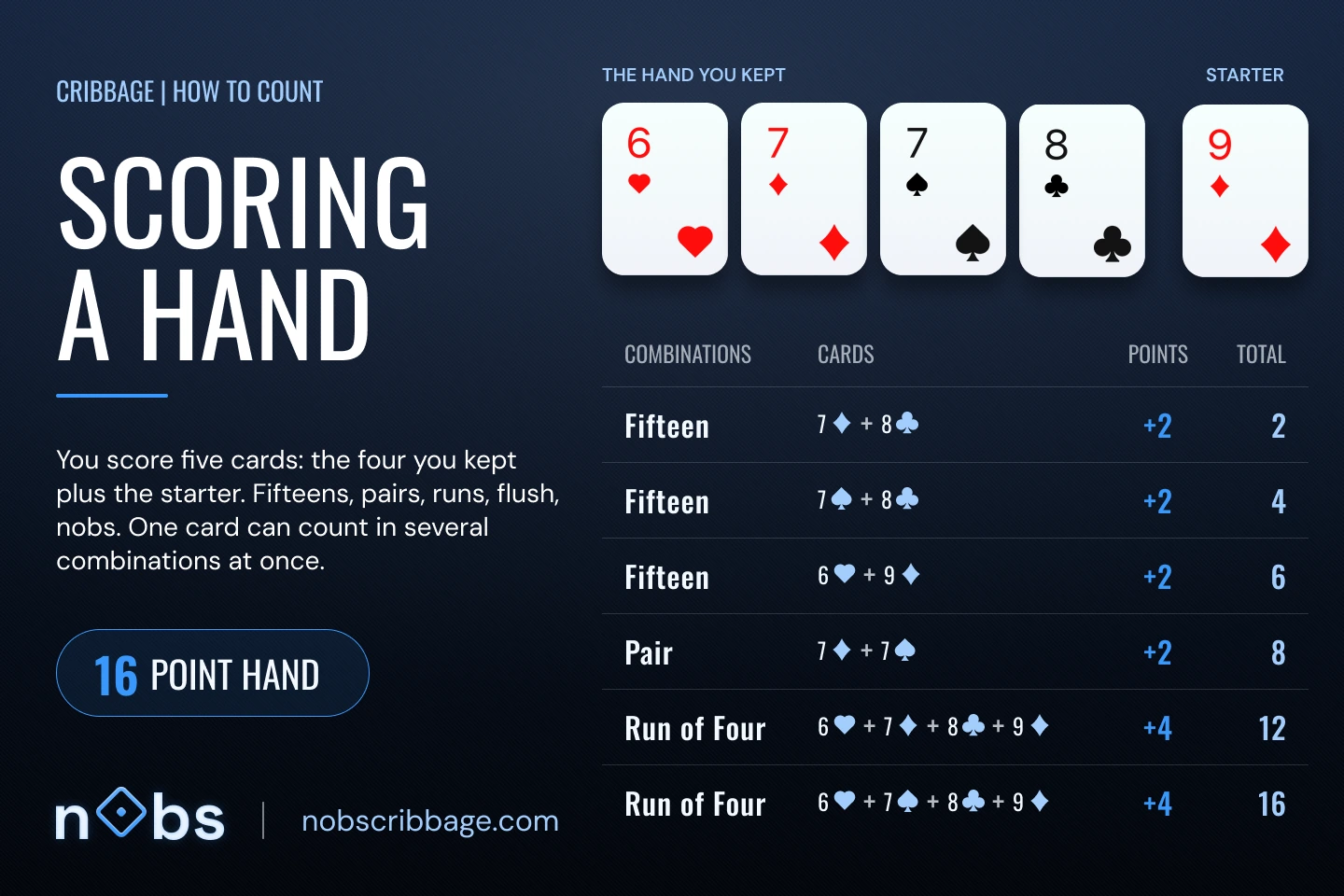
Can the same card count in more than one combination?
Yes. A card may sit in as many combinations as it genuinely belongs to, and big hands depend on exactly this. In the example above the 8♣ works four times: once in each fifteen with a 7, and once in each run of four.
What never repeats is the combination itself. Two combinations are distinct only when they differ by at least one card, so you cannot count the same fifteen or the same run twice.
Do the runs of three inside a run of four count?
No. A run scores only at its longest length, so 6-7-8-9 counts 4 points as one run of four, never 4 plus its two overlapping runs of three. The same holds for a run of five, which is worth exactly 5.
Paired ranks are the one honest multiplier. In the worked example the two 7s create two genuinely different runs of four, because each run uses a different 7, and each scores its full 4 points.
What does the starter card add?
The starter counts as a fifth card in every hand and in the crib at the show, so all your fifteens, pairs, runs, and nobs can reach through it. A starter that matches all four hand cards' suit also upgrades a flush from 4 to 5.
One starter score is separate: when the starter itself is a jack, the dealer pegged 2 for his heels at the moment of the cut. That point belongs to the cut, not to the count of any hand.
What's different about scoring the crib?
Almost nothing. The crib, the four discarded cards owned by the dealer, is counted last, after both hands, with the starter as its fifth card. It uses the same combinations at the same values, including nobs for a crib jack matching the starter's suit.
The single exception is the flush in the crib: the crib scores a flush only when all four crib cards and the starter share one suit, for 5. Four suited crib cards alone score nothing.
Can a hand score nothing?
Yes. A hand with no fifteen, no pair, no run of three, no flush, and no matching jack scores zero, and players traditionally announce it as "a nineteen hand". The joke works because 19 is a total no cribbage hand can actually make.
Counting at a real table with real cards? Muggins is a digital cribbage board: lay the phone flat between you, play with your own deck, and pull the knobs to peg what you count. The app keeps the score; the cards stay real.